
❦ TEXTCAST · No. 002 · Indie iOS
“Nobody finishes a journaling app. I wanted to build one you'd actually want to open.”

By Bas Fijneman
❦ The founder, at a glance
- Just launched · Solo · bootstrapped
- 2026
- Just me (Fijneman Creatives)
- Netherlands
- PufferPages
- pufferpages.com · App Store · X (@bas_fijneman)
❦ Part · From forgetting the year to a comic a day
On building PufferPages, solo, in 11 days
What made you start what you're building?
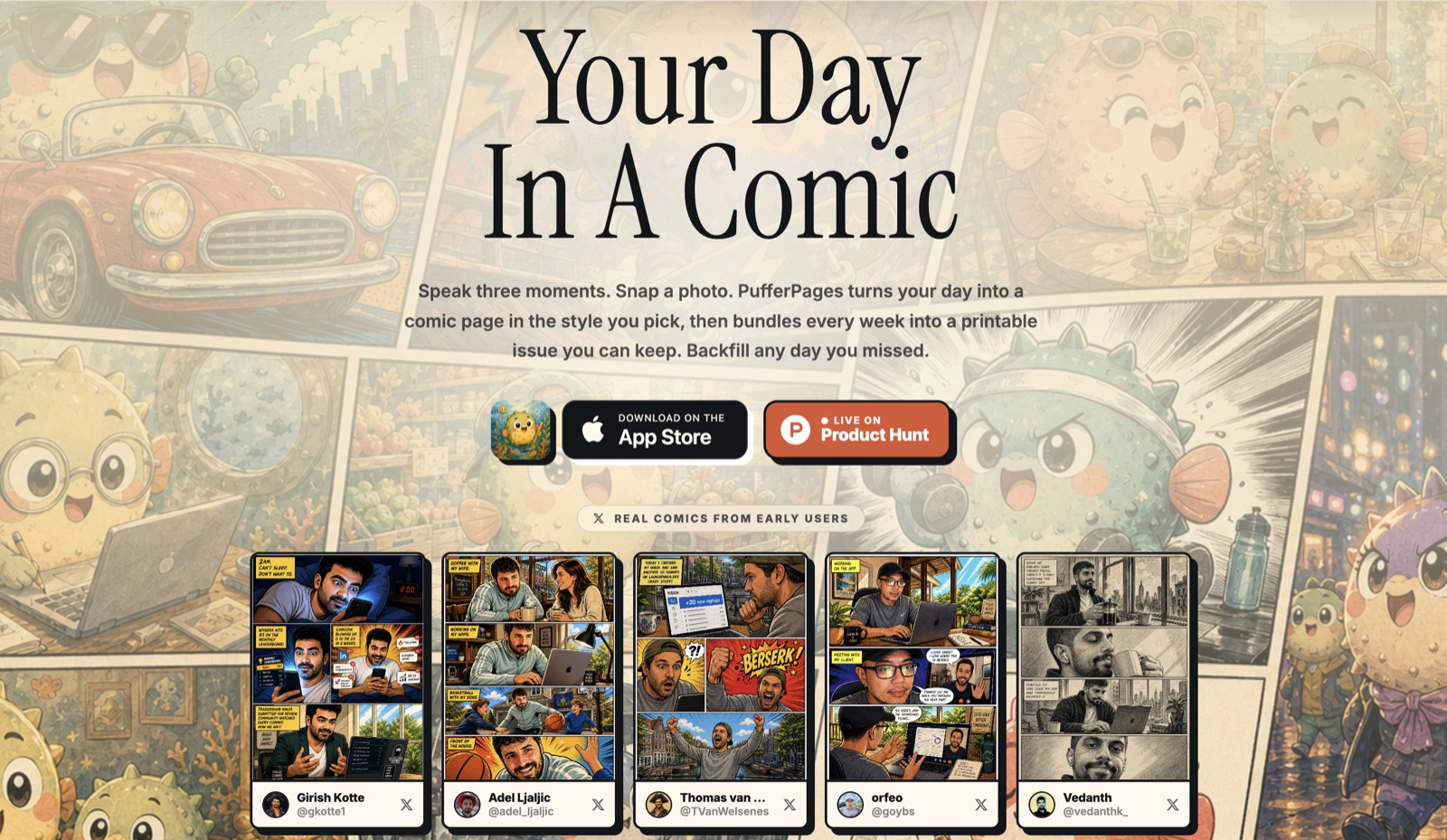
Honestly, I forget what I did all year. A whole year goes by and I cannot really tell you what happened in it, and that hit hardest with my kids: the small moments, the things they say, the ordinary days that are actually the whole point. I didn't want to sit down and write paragraphs every night. I wanted to jot a few moments during the day and end up with something I'd actually enjoy looking back on. PufferPages takes those few points and a photo and turns the day into a comic page, so the year stops disappearing on me.
What was the moment you knew it was worth doing seriously?
I built the first working version in about 11 days, head down, because I could not stop thinking about it. The moment it clicked was seeing a completely ordinary day come back as a comic page and catching myself grinning at it. It wasn't accurate, it was better than accurate. The people I showed it to immediately wanted their own, wanting to see themselves in it, and that pull was the signal that this was worth taking seriously.
❦ Part · The build
The stack, and the part that's actually hard
What's your current stack and why?
Expo and React Native so one person can ship a real iOS app fast, with TypeScript in strict mode to keep me honest. Supabase for auth, Postgres with row-level security, storage, and edge functions. All the heavy lifting (image generation through Fal AI, the prompt planning) runs server-side in edge functions so no API key ever ships inside the app. RevenueCat for subscriptions, because hand-rolling Apple billing would have cost me weeks. PostHog for analytics. The whole point of the stack is to let a solo founder move like a team.
The stack, in one place
What one person uses to move like a team:
- 01Expo + React Native — ship a real iOS app solo, fast
- 02TypeScript (strict mode) — keep yourself honest
- 03Supabase — auth, Postgres with row-level security, storage, edge functions
- 04Fal AI — comic generation, server-side only so no key ships in the app
- 05RevenueCat — subscriptions without hand-rolling Apple billing
- 06PostHog — analytics
- 07NativeWind — styling
- 08Claude Code — building
What's the biggest mistake you've made so far?
Assuming the hard part was generating a nice-looking comic panel. It isn't, that part is basically solved now. The hard part is keeping the person actually recognisable as themselves, in a different pose and mood than the selfie you handed it, panel after panel. The model loves to just copy your reference photo's expression into every frame. I underestimated how much of the work would go into making you still look like you, and learned that the hard way once I thought I was almost done.
❦ Part · Getting users, making the math work
Word of mouth, and a margin most apps don't have to think about
How are you finding your first users (or readers, or customers)?
Word of mouth, mostly. People see a friend's comic page and ask what made it. I share the build and example pages on X, but honestly the app itself is the best ad: every page someone shares is a working demo.
What's a non-obvious thing about your business model?
Every comic costs real money to generate, so unlike most subscription apps my margins live and die on usage, not just churn. That shapes everything: why the first comic is free, why the heavy generation sits behind Pro, and why I watch cost per page as closely as price per month.
❦ Part · What's held up
The rule that survived, and the advice he'd send back 12 months
What rule have you kept that's paid off?
Keep the daily loop tiny and fun: one entry, one comic, one tap. Every time I was tempted to add a step I cut it instead. The weekly printable issue is the only big feature, and it only works because the daily habit is effortless.
What would you tell yourself 12 months ago?
Put the magic moment first and build backwards from it. You'll be tempted to build the auth, the tiers, all the scaffolding first. Get one real comic of your own day on screen as early as you possibly can. Everything else is in service of that one moment.
❦ ❦ ❦
❦ Lightning round
Quick answers, short clock.
Best tool you didn't expect to pay for?
RevenueCat. Handling Apple subscriptions myself would have cost me weeks I didn't have.
Where do you actually find users?
X, and the people who see a friend's comic and ask what app made it.
One thing that's overrated?
Adding features. Most days the app needed less, not more.
What's keeping you up at night?
The cost of generating each comic versus what people will happily pay every month.
❦ Key takeaways
- ●Make journaling a reward, not a chore.
- ●Ship the smallest loop that's genuinely fun on day one.
- ●Anything that touches an API key belongs server-side, never in the app.
❦ Interviewed by Girish Kotte for FoundersHub
❦ Where to find them
- PufferPages on the App Store
Free to start — the first comic's on the house.
- PufferPages website
Example pages and the build, in public.
❦ Your story
Want to share yours?
We read every submission. We publish the best — your words, no ghostwriting.
Apply to be featuredThe Founder's Stack
One tip, one comparison, one founder story.
Every week. No noise.