❦ TEXTCAST · No. 001 · Multi-product
“I want to be a fish in the ocean, not in a well — limited to where I can already swim.”

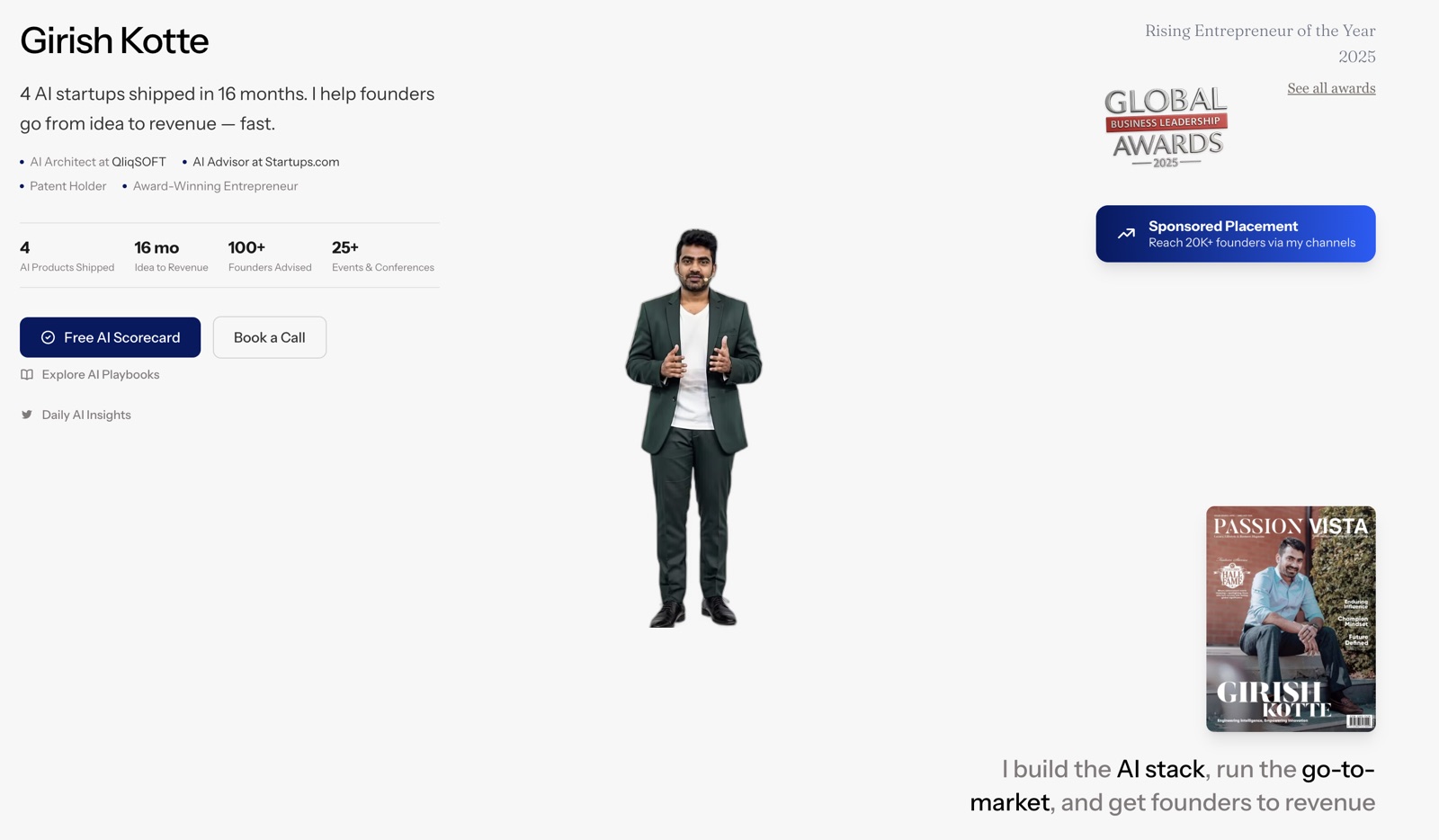
❦ The founder, at a glance
- Day-job + the rest of the day
- Wyse Atlas · Postwyse · Opswyse · Tradinghub.ninja · PromptPro · Foundershub
- Me + 1 (100+ interviews to find him)
- 2015, for the master's
- IEEE Sr Member · Author · Patent holder · Speaker
- gkotte.com · X · LinkedIn · events across the US
❦ Part · From a 9-to-5 to the ocean
On the journey from internship to startup founder
What made you jump from a stable job to startups?
I've been into software and laptops since I was a kid. Came to the US in 2015 for my master's, got an internship at a big enterprise company, and almost immediately knew it wasn't for me. Enterprise moves slowly. I wanted to learn everything — DevOps, integrations, product, mobile, sales, the whole thing. So I took my first full-time role at a startup. The pace fit. Then management dropped a brand-new project on me, R&D to production, and let me lead the team. That was the moment the day-job version of me started fading.
How did Tradinghub.ninja start?
Trading is a personal passion. I built a bot and a set of indicators for myself over weekends — the kind of thing you make because you want it, not because you're starting a company. I showed it to people at meetups; they asked how much to use it. That was the signal. We rolled it out, and now there are 3,000+ users across multiple Discord and Telegram channels. Two student interns run it day-to-day. It still grows, and it could grow bigger — but it's not what my heart is pointed at.
Why move from trading to Wysera?
Trading is my passion. Wysera is my work. I wanted to solve something bigger than my own P&L. The pain points I hit running Tradinghub — fragmented tools, data nobody could query, having to glue together five SaaS products to do one thing — that's where Foundershub started. Then Foundershub became Wysera. Started as a small idea: pull Popl, Calendly, blogs, newsletter, and CRM into one place. It kept maturing. Now it's Wyse Atlas — an agentic platform, not a CRM. Full agentic flow. One tool an org can actually run on.
❦ Part · The Wysera goal
What's Wyse Atlas, exactly?
It's the agentic flow for running a small business. The premise: any org needs one tool to run on, so the AI can actually understand the data. Right now most small businesses run on Google Sheets and a stack of free-tier SaaS — not because that's the right answer, but because HubSpot costs more than payroll. Wyse Atlas is the one-tool version of that stack, with AI built in so the data isn't fragmented across ten places where nothing — not the AI, not the owner — can make sense of it. In beta with 25+ clients, 5+ already migrating from HubSpot, a few have called it the best platform they've used.
Who is Wyse Atlas really for, and what's the pain it removes?
Owners who can't justify HubSpot or ten separate SaaS subscriptions, and don't have a RevOps person to wire them together if they could. The current default for that segment is Google Sheets plus a folder of half-used free trials. The pain isn't that any one tool is bad — it's that nothing talks to anything, so AI can't help, so the founder is the integration layer. Wyse Atlas is for the founder who'd rather be running the business than translating between five tabs.
❦ Part · The honest-editorial principle
On including your own products in your own directory
What's the rule for including your own products in Foundershub?
Same rubric as every other tool. Same five-dimension score breakdown. A visible disclosure on every detail page and every comparison page where they appear. The result is checkable: Buffer beats Postwyse in /compare/buffer-vs-postwyse. HubSpot beats Opswyse in /compare/hubspot-vs-opswyse. The disclosure is the editorial cost of admitting the products in — and it's a cost worth paying, because it earns the trust the inclusion would otherwise spend.
What's the test you apply before publishing any review or comparison?
Would I be comfortable sending this to the vendor's CEO and defending every line? If not, the wording is wrong. The vendor doesn't need to like the review — they need to recognize it as fair. That's the bar. Same bar for my own products. It's the only one that works for both readers and the people we're reviewing.
❦ Part · The hard parts founders don't say out loud
Starting a startup is not vibe coding
What no one tells you about starting a startup?
Behind every screen, there's pressure people only describe after they've survived it:
- 01Competitor pressure is constant. There's always someone you didn't expect.
- 02You can't spend time with family or friends the way you used to. The relationship cost is real, and you'll undercount it for years.
- 03In the fast pace, you'll sometimes run hard in the wrong direction. The skill is noticing earlier, not running slower.
- 04You'll pick the wrong cofounder at least once. Like the meme: it's easier to pick a wife than a cofounder.
- 05You'll lose money on logos, swag, booths you set up without a plan. Every founder makes these mistakes; the trick is getting cheaper at them.
- 06Sleepless nights. Health hits. Wrong hires. I interviewed 100+ people before I found the one teammate I have today — that's the cost of getting the first hire right.
What did you waste money on that other founders should skip?
Logos before product. Swag before customers. Conference booths I'd designed without a single conversation booked. Branding exercises that felt productive but didn't move a single metric. The pattern: anything that makes you feel like a real company before you have a real customer. The fix isn't perfectionism — it's compressing the time between mistake and recovery. I made every mistake on this list. I just stopped staying in them.
What's the one thing you wish someone told you earlier?
Be passionate about what you're doing. Not the idea of building — the actual thing you're building. Every mistake is recoverable if the passion is real, because passion is what gets you back to the desk on the day you'd otherwise quit. Trading was passion. Wysera is what I love. Knowing the difference is the thing nobody told me, and the thing I'd say first to anyone asking.

❦ ❦ ❦
❦ Lightning round
Quick answers, short clock.
Best advice for first-time founders?
Be passionate about what you're doing. The rest is operational.
Worst tool decision you ever made?
Logos, swag, and a booth — none of which I'd planned around a conversation.
One thing that's overrated?
Cofounders. (It's easier to pick a wife than a cofounder.)
Where do you find users?
Meetups. Build something for yourself, show people, wait for the 'how much?' moment.
Most underrated credential?
Having shipped six products you can name. Patents and awards are a nice second.
Best free tier you actually use?
Google AI Studio (Gemini) — the free tier is genuinely usable for prototyping, not a toy. And Groq for absurdly fast free inference when latency matters more than model choice.
What's keeping you up at night?
Money compounds. Time only counts down. Don't be lazy with the asset you can't refill.
❦ Key takeaways
- ●Be a fish in the ocean, not in a well — pick the work that has no ceiling above your skill.
- ●Trading was passion. Wysera is what I love. Don't confuse the two — passion is what gets you to the desk on the day you'd otherwise quit.
- ●Most orgs run on Google Sheets because HubSpot is too expensive. That's the gap Wyse Atlas is built for.
- ●Don't be afraid of mistakes — but come out of them quickly. The compression time is the real founder skill.
- ●It's easier to pick a wife than a cofounder. Choose with the same care, and let go faster than feels comfortable.
❦ Interviewed by Girish Kotte for FoundersHub
❦ Where to find them
- Wysera.ai (parent brand)
The flagship — one tool to run a business so AI can actually understand the data
- Wyse Atlas
The agentic platform: one place for Popl + Calendly + blog + newsletter + CRM, with AI on top. In beta with 25+ clients (5+ migrating from HubSpot)
- Postwyse
AI social scheduler with voice cloning
- Opswyse
CRM for solo founders and small teams
- Tradinghub.ninja
Trading bot + indicators — 3,000+ users across Discord and Telegram, run by 2 student interns
- PromptPro.live
Teaching students to prompt — the skill that does the heavy lifting for the next decade
- Foundershub
This directory — built so founders don't end up where I almost did
❦ Your story
Want to share yours?
We read every submission. We publish the best — your words, no ghostwriting.
Apply to be featuredThe Founder's Stack
One tip, one comparison, one founder story.
Every week. No noise.